Wednesday, October 19, 2005

Mission to Sarajevo

 The Balkan conflict of the 90s was a real mess. When Tito died in 1980, Yugoslavia started falling apart. It was a country that had been used to being ruled autocratically since the Second World War. They sputtered on for about 10-12 more years, but after the Berlin Wall fell, there was no “umph” left in dictatorial rule, so it dissolved in spring of 1992 into Croatia, North Macedonia (Macedonia is a state in Greece where Alexander the Great is supposedly from, so there is NO WAY they are giving up their name), Slovenia, Montenegro and Serbia.


Simplified: as is typical in old, well established areas that have been forced to live together against their will for decades, a lot of old animosities simmer, and they boiled over when Bosnia (Muslim) attempted to separate itself from Serbia (Orthodox). The US got involved as part of a NATO peacekeeping force when the killing in Bosnia got too severe, and the city of Sarajevo was surrounded and in the process of being starved out.

I think I flew to Rhein-Main AFB in Germany sometime in September. For the next two to three weeks, as part of a NATO humanitarian relief effort called Operation Provide Promise, we flew plane loads of relief supplies pretty much every other day. My missions were all airland, but later guys were doing high altitude airdrops of MREs (Meals Ready to Eat), where large refrigerator boxes would be pushed out of the plane and then fall apart, raining plastic packages the size of bread loaves containing basic meals down on people’s heads all across Bosnia.

We would load up in Germany, fly over Austria, down the Italian coast, then across Croatia into Bosnia. All high level. We flew high because the Serbs were using anti-aircraft guns mounted up in the hills overlooking  citites and towns to shoot down into them, and we didn’t want them to start aiming them up at us.
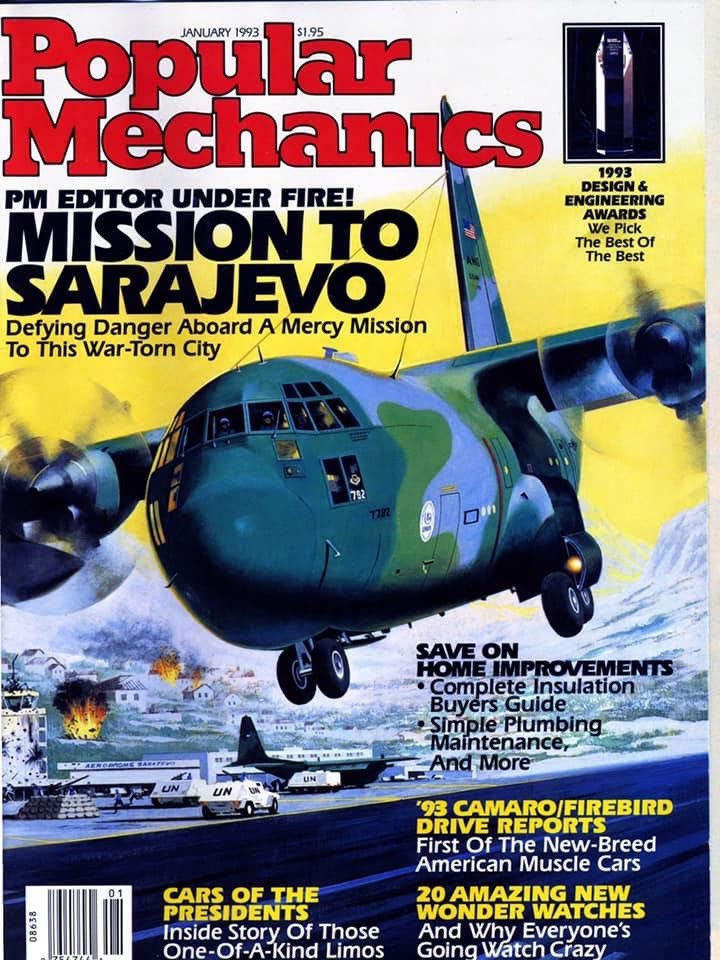
About 50 miles out we would start talking to the French air traffic controllers who were controlling the air traffic in and out of the Sarajevo airport. We all had slot times we had to make +/- a minute or so. Once we were cleared in we would press into about 25 miles, over the top of a pretty significant valley, slow down, drop flaps to provide drag, and then pretty much drop out of the sky in a very significant manner. I would call out distance to go and required altitude to remain on glide slope to the airport. All to attempt to stay above any groundfire that someone on the hillsides might decide to aim our direction. 

Then we had to make sure we landed within the first 2/3s of the runway, because the Serbs were firing those anti-aircraft weapons (cannons) across the runway into the apartment buildings across from them. If you were too fast and felt you couldn’t land and stop in time, you were to abort the landing, and try again, climbing out as fast and as steep as you could. It was quite a rush.

We would taxi into the parking ramp, turn and back up to the main building, drop our ramp, using the airplane as protection for people unloading in the back…small comfort for us sitting ducks up in the cockpit. Passengers would rush off, cargo would be pushed off on to awaiting forklifts, new passengers waiting to get out would rush on, we would close up and taxi out, taking off pretty much empty from mid-field. I started timing our total time on the ground after about the 2nd mission. I think by the end, we got it down to something like 5 minutes. It got to be a well-oiled, choreographed operation.

We would fly out to the city of Split, in Croatia, about 45 minutes away, upload any passengers or cargo awaiting there, head back to Sarajevo, do the same ordeal, then take off again and head back to Germany to make it a day. Fun times. The next day or the day after, at the latest, we do it again.
In 1995 I went back again for a couple weeks because it was no longer a NATO relief operation, it was a military operation called Operation Joint Endeavor. For us, the only thing that changed was that it was designated combat missions and we were flying out of Ramstein AB instead of Frankfurt. Had a couple flights down into the Mediterranean, and the beer was still good.

Sunday, March 27, 2005

Operation Southern Watch, Saudi Arabia, 1993

 I left Active Duty on 1 May, 1990, because the Berlin Wall fell the previous fall, the Soviet Union was falling apart before our eyes, and I was sitting B-52 alert, living away from my family, one week out of every three for no discernible reason. The next day, I was in Pittsburgh at my first Unit Training Assembly (UTA), or what most people call Drill weekend (“One weekend a month, 15 days a year,” My ass!) On to the world of C-130 Tactical Airlift.


Almost immediately, Iraq invaded Kuwait, and within several days, guys from my Bomber unit deployed to Diego Garcia to be in place if we were to take it back (We did, and they flew downtown Baghdad low level the first night of the war). I, on the other hand, sat at home and worked my new civilian job as a Quality Engineer at Cooper Power systems, and slowly got up to speed in my new airplane. It took a couple months because I would only go in during the evenings to study with an Instructor Navigator, or fly. I ended up taking my high level checkride in about October or November. 

     When it looked like we might deploy, all of a sudden my check ride for being “Mission” Qualified” (able to fly low level, and deliver supplies either via airland and/or airdrop) was condensed into two demo rides and a check ride. Needs of the Air Force.

     But we didn’t go… because Turkey suddenly backed out of letting the US stage out of one of their airports. We were geared to do a huge paratroop drop of the 173 Infantry Brigade out of Italy into Northern Iraq to secure the airfield, but that was cancelled. (Ends up C-17s did it later and threw their troops all over the sky, some miles from each other). So, I spent the “Gulf War” (Feb -Mar ‘91) flying out of Pittsburgh and other places, moving supplies and weapons to the coast where either C-5s &C-141s, or ships took them to Saudi Arabia.

     After the War was done, there was an operation, Operation Southern Watch, set up to monitor the Iraqis and ensure they behaved. C-130 units took turns sending crews and planes over to move stuff around. Our base got tagged in late January of ‘93. I really wanted to be a part of SOMETHING, so I volunteered to fill a spot with a Youngstown crew that was going at the same time as crews from my unit. I flew over with them, stopping in St. Johns, Newfoundland; probably Mildenhall, England; Crete and finally Dhahran, Saudi Arabia, where the US set up an operating base on the Persian Gulf.

     Our job was to fly around the entire Persian Gulf moving stuff from one place or the other. I found out that flying around Saudi Arabia is much like driving across Texas. It takes forever! Miles and miles of nothing, Then suddenly a huge city. Then nothing. 

     My Youngstown crew had two pilots who were planning to fly for the airlines, so they would fly as slow as possible across Saudi Arabia in order to build up flying time. It was agony. Luckily, I only had about three missions with them, when someone realized that one of the Pitt crews had a married couple flying together, the guy was the Nav and the girl was the Aircraft Commander. When brought to his attention, the  Commander put a quick stop to that! So they swapped Navigators, and I went to the Pitt crew, while the married Nav came to my Youngstown crew.

     We were staying in the Khobar Towers, right next to the airport. Big US compound made up with a bunch of high rise apartment buildings the Saudi government built to provide homes for the Bedouins using all their oil money. Unfortunately, Bedouins like their nomadic lives where sheep and goats and camels could roam with them. The apartment buildings didn’t provide for any of that, so they never got used.  Very nice place. I think I was up on the 7th or 8th floor. Huge place that had 4 or 6 bedrooms, marble floors, balconies, huge flat screen TVs, etc. 

     Interestingly enough, those high rise dorms were the ones bombed by terrorists three years later, on 25 Jun, 1996. I remember sitting on the balcony overlooking the security fence line and the entry checkpoint thinking how close they were. Timing is everything.


     As I stated before, the flying was pretty boring. We’d leave Dhahran, fly all the way down to Oman, the UAE, Yemen or the Southwest corner of Saudi to Khamis Mushait (and pick up U-2 surveillance camera film and take it to the HQ at Riyadh for analysis. Other times we’d go to some pretty obscure places that didn’t even have full runways yet (we’d land on the taxi-ways), where we’d pick up pallets of old bombs, mines, ammo, bullets, etc, and take them to a base called Al Kharj… we called it Al’s Garage… where they would collect it for storage or shipment back to the States.

     It was a fun month of seeing more of the world than I had done before. 

     All too soon it was over, and I was back in the US. Within a day or two of my return, the “Blizzard of ‘93” hit, which was quite a dichotomy from what I had been used to the past month or so. I think we were snowed in for at least three days… the roads were impassable for at least one. Luckily, Laura had a Mazda MPV by then, and we could get out and about Zelienople fairly quickly after we dug it out.

Sunday, March 7, 2004

Kenneth Holland

These are men who inspired me as a kid. Hardworking men of the earth and sea. None of them were perfect, but each lived life on his own terms. If I can only come close to living the lives they've led, I'll have been successful.

The fishermen know that the sea is dangerous and the storm terrible, but they have never found these dangers sufficient reason for remaining ashore.
~ Vincent Van Goh


(Ken is my Mom's oldest sister's husband, and lived two doors down from us on Jura Beach, in Anacortes, WA.)

A lifelong salt who spun a fine yarn, Kenneth Holland, 75, died Saturday, March 6, 2004, at his home in Anacortes, from complications of chronic emphysema, a disease common to smokers.

The crab fisherman who spent decades battling big swells and slop in the waters of Washington and Alaska was born Dec. 23, 1928, on dry land in Copperstown, N.D.

His family moved to Olympia when he was a boy, and he fell in love with the sea, floating off on logs or hobbled-together rafts. After his family moved to Anacortes, the young teen canvassed and tarred a kayak frame and paddled solo from island to island in the San Juans.

That would be the first of many boats Kenneth would build, including a beautiful mahogany hydroplane, an 18-foot sailboat, custom kayaks and a classic 26-foot Columbia River double-ender.

After graduating from Anacortes High School in 1947, Kenneth went to work in the local plywood mill his father supervised for more than a decade.

In the mid-1950s, he began crabbing local waters in a flat-bottomed, 19-foot skiff, selling his catch on weekends from a pickup at Sharpe's Corner, along with his wife Carolyn Holland.

Kenneth bought his first crab boat, the F. V. Dora H in 1964, followed by the 72-foot Point Omega, the 98-foot Carolyn Jean and the 98-foot Barbarossa. Kenneth and his crews crabbed the waters off Kodiak Island, working short seasons and long hours. His men described their skipper as "all business" behind the wheel.

After he became sick with emphysema, Kenneth, staring out at Similk Bay from his beachside home, would regale friends and family with lively tales of the sea.

He would describe horrific swells, rogue waves, 80 mph southwesters, weeks without sleep and catches that might or might not make it all worth it.

"You always hope for the best and you usually end up with the worst — but that's fishing," Kenneth often liked to say.

He is survived by his wife of 56 years, Carolyn; his sons and daughter-in-law, Kenneth and Christine Holland of Kodiak, Alaska, and Richard Holland of Anacortes; his daughters and son-in-law, Kathryn Holland of Anacortes and Rebecca and Kenneth Bangsund of Everett; his seven grandchildren, Shawn and Megan Holland and Sunshine and Aaron Stevens of of Kodiak, Serina and Matthew Armstrong, Karen Bangsund and Devin Bangsund of Everett and Travis Smith and Vannessa Biggers of Anacortes; and four great-grandchildren, Winter, Hunter, Zanna and Kadin Stevens.

Kenneth will be cremated and buried at sea, with no formal services. His family has asked that memorials be sent to Skagit Hospice Foundation, P.O. Box 1376, Mount Vernon, WA 98273; or Children's Orthopedic Hospital, MS/S-200, P.O. Box 50020, Seattle, WA 98145-5020.

Arrangements are in the care of Evans Funeral Chapel of Anacortes.